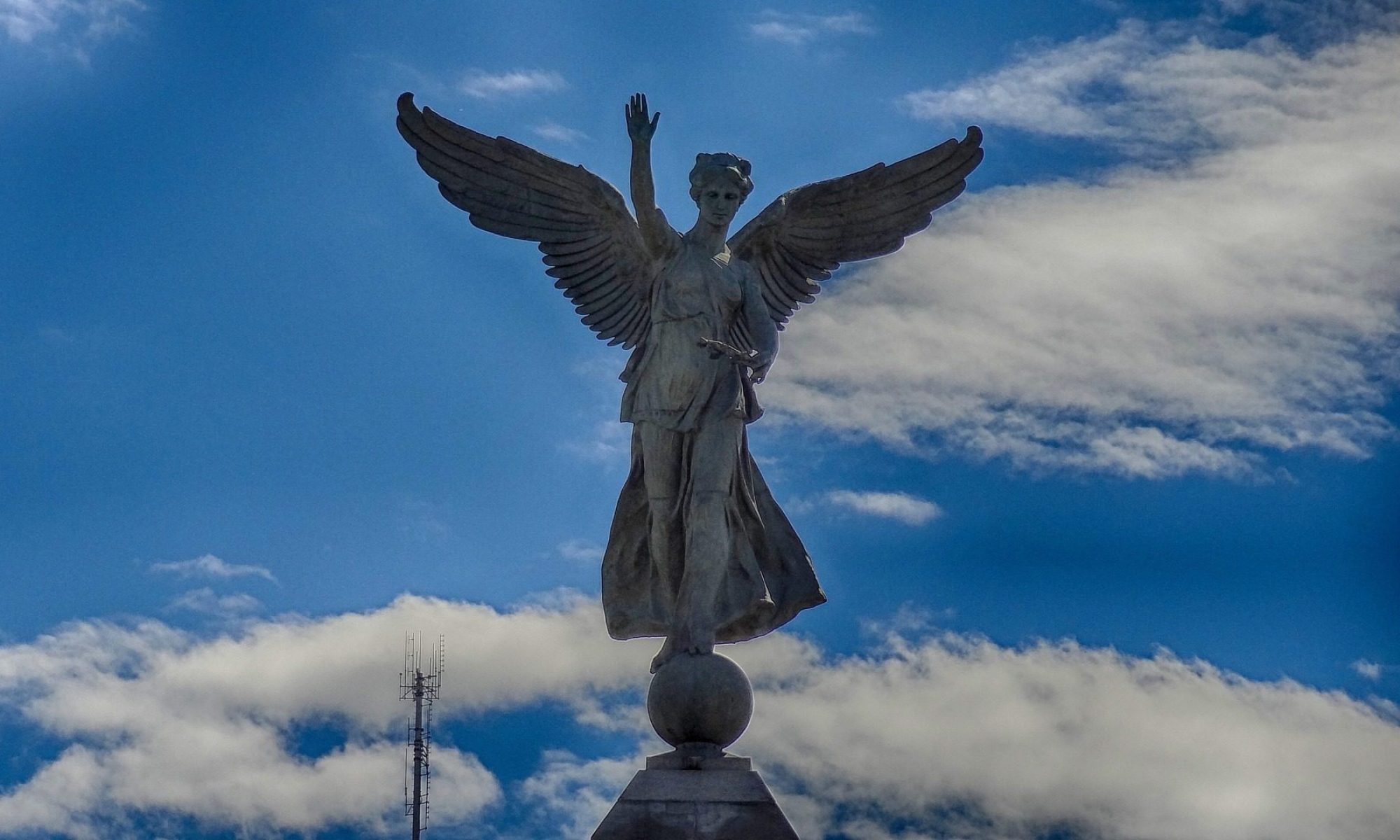
Clifford on My Mind

Happy Father’s Day to all good fathers and grandfathers!

When my Grandpa Wilson—Clifford—comes to mind he arrives like a seductive sax in a jazz riff that rises above the noise during brunch rush. He was always there, but until a minute ago, I didn’t notice him.

My whole world turned upside down when I was seven, and in the turning a new cast of characters entered, including Clifford and Grandma Wilson—Mildred—and their dog C’est La Vie. We moved that year a few blocks away from them and got our own dog, Cooper. Most afternoons Clifford would pick up me and my brothers and Cooper in his white four-door Chevy and take us for walks at Good Templar Park less than a mile away. C’est got pride of place in the passenger seat while the rest of us sat in the back. 

Over time, my brothers dropped out unless there was a big snow and they wanted to sled Dead Man’s Hill. With nothing better to do, I was steadfast. Clifford usually parked in the cemetery where we often walked before or after we set out for the adjacent woods. I learned about different grave markers; an ivy wound tree stump with a child’s winter cap atop and a single blade pair of skates leaning against belonged to a boy who drowned skating. The big armchair where I liked to sit was where Loie and Hal Naylor were laid to rest, the engraving on the back, “Pals.” Clifford showed me where my mother’s grave was, something no other adult had thought to do. 

Most of our time, though, was spent walking in and around the woods. There was a creek that ran cool all year where I wanted to be timed standing in my bare feet to see how long I could take the cold, my version of a polar bear club. From the creek, we climbed a hill that was covered with Lily of the Valley in springtime. When we reached the top, Clifford would find a spot to eat an apple and take a nap in the sun on a slope that faced west with a view of the Fox River. I would climb a favorite tree and survey the meadow and the walnut trees, jumping down when I saw him coming with the dogs.

We didn’t talk much, Clifford and I, but a lot of healing took place on those walks where nature and steady presence were good medicine. They still are and so is a seductive sax that rises above the noise and catches me by surprise.
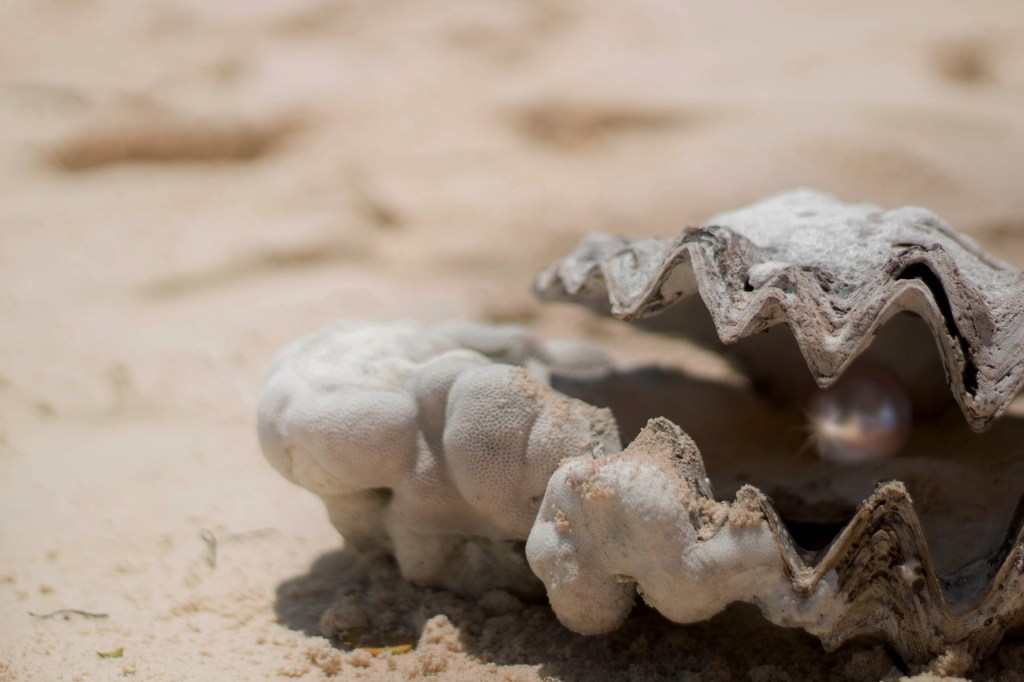
Pearl Cocktail

Image by Schaeferle from Pixabay

What do Kamala Harris, Elizabeth Taylor, Rumi, Grace Kelly, Jackie Kennedy, Coco Chanel, and Shakespeare have in common? A love and appreciation of pearls. And they are not alone. For centuries pearls have been equated with prestige and wealth, metaphors for transformation in literature, art and philosophy, and symbols of luck, beauty and purity.

The lore and allure of pearls is as vast and varied as the bodies of water from which they are harvested. Venus and Aphrodite were said to have emerged from an oyster shell. And if the story is true, Cleopatra famously set out to impress Marc Antony when she wagered a bet with him that she could host the most expensive dinner in history, thereby exhibiting Egypt’s wealth. She finished that meal with a cocktail made from one of her own very expensive pearl earrings—worth millions even then—crushed and dissolved in a goblet of vinegar wine. Wager won. 

Pearls are formed when an irritant works its way into an oyster, mussel or clam causing a defense mechanism to secrete a fluid, nacre, that coats the irritant in layers to form a luminous pearl. It can take anywhere between six months to four years for a pearl to be ready for harvest. Cultured pearls are surgically removed without harm to the mollusk, and sometimes an irritant is reintroduced to seed the growth of another pearl.

In a letter to his brother Theo, Vincent van Gogh wrote: “The heart of man is very much like the sea, it has its storms, it has its tides and in its depths, it has its pearls too.” Some of the pearls that are formed from the irritants that land on the mantles of our hearts and souls are never harvested, while  others can take a lifetime to harvest. The removal of them is a delicate process, not always as surgically precise or efficient as those harvested from oysters, but the yield is as priceless as a cocktail concocted by Cleopatra herself. 

FRAGILE


(Cambridge Dictionary) adjectiveUS   /ˈfrædʒ.əl/ UK   /ˈfrædʒ.aɪl/

easily damagedbroken, or harmed

Be careful with that vase – it’s very fragile.
The assassination could do serious damage to the fragile peace agreement that was signed last month.
I felt rather fragile (= weak) for a few days after the operation.
UK humorous No breakfast for me, thanks – I’m feeling a little fragile (= ill, upset, or tired) after last night’s party.

There is a package on the front porch stamped FRAGILE. I feel like I need to have that stamped on my forehead and should behave as though everyone else has it on theirs.

I’ve broken many fragile things in my life, including expectations. In most cases I was careless, carrying too much or not watching what I was doing, crestfallen over the resulting broken item. Or I was insensitive, had a hair trigger reaction, not thinking through how my words/actions might land, not anticipating the feelings of others. This past year I confess, not with pride, to more of that than usual.

We are all worn out and fragile from helplessly watching a pandemic take so many lives and hurt so many loved ones, from the changes it has brought to our lifestyles. Our healthcare professionals—truly heroic always and most especially now—are raw with fatigue. We’ve lost some of them to the novel coronavirus, some to depression, even suicide. 

This massive public health issue is overlaid atop issues that have reached a critical point of no return—racism, violence, climate change, economic injustice, more. Several people I know are also going through personal challenges and losses. Unemployment is high, many are struggling to pay rent and mortgages, to put food on the table.

Even in the best of times, we are fragile packages in a very fragile world, and inside fragile packages are both dangerous things like ticking bombs and priceless, beautiful, breakable things like fine crystal. A fragile vase, even one that’s been broken and glued back together, can still hold water.

This cracked old vase spilled some this morning reading the headlines about the vaccine-filled trucks going on the road. The great conjunction of Jupiter and Saturn—forming the Christmas Star or Star of Bethlehem—will occur on the solstice. It has not been this visible since 1226. In January, a new administration takes office in the US. Out of our fragility rise embers of hope, joy, light, strength.  

Happy Solstice, Joyeux Noël!

A Fine Sermon

Osprey: Audubon.org

At times we all have attention deficit disorder to varying degrees, and that may be truer these days than ever.  I try to cut myself some slack when I find I am staring out the window more often, thinking about not much.

My colleagues know that it’s not unusual for me to be distracted to the point of stopping mid-sentence when I see a raptor out of the corner of my eye. So, it wasn’t that unusual that I was captivated by a white-headed bird perched in one of the trees on the lower part of the cliff. Her head made her conspicuous among the leaves in mid-autumnal wardrobe change. From where I watched, she didn’t seem that big until I put a pair of cheap binoculars on her. Whoa. Was she a bald eagle? An osprey?  Come on, turn to me, let me see your face. Alas, she stayed still, lost in her own private worship of the river.

I stood watching her for five or ten minutes, telling myself I needed to get back to work, but I longed to see her more clearly and to watch her take flight, as I knew she eventually would. Did I really have better things to do? I suppose that might depend on who was being asked. My shoulders started getting tight from leaning against the window ledge with the binoculars pressed to my face.  Ah, there, she spread her wings and turned her masked face my way. Oh divine osprey, you lured me, not for the first time. But she was just shifting in her pew, resettling for a longer meditation, and I was becoming impatient, antsy to leave church. 

Here’s the thing about nature’s divine goddesses; they don’t change their rhythms to suit anyone. They will be still as long as necessary, take flight when the time is right and soar when it’s time to soar. I settled in for what turned out to be a long sermon that, in the end, refreshed my memory about natural rhythms, about patience and stillness, really bringing it home when she finally spread those awesome wings and flew north along the Hudson. Hallelujah!

You Are a Superhero

Several years ago, I attended a dinner party in Washington, DC where there was a lively discussion about whatever political crisis was happening then, perhaps the Clinton-Lewinsky scandal or maybe it was the Weapons of Mass Destruction and the Iraq War. Whatever it was, the volume got louder while I sat mutely wondering how to insert myself. And then our hostess leaned into me and said, “Can you believe what happened in Rex Morgan today?” making me laugh, landing me back on terra firma. For those of you unfortunate enough not to know, Rex Morgan, MD is a long-running soap opera comic strip.

It’s rare this year to be at many dinner parties. Nor do I suppose Rex Morgan, MD could come to my rescue during this time of colossal crises. But when things are as they are—so outsized and incredulous as to be nearly unbelievable—it’s hard for me not to think in mythological, archetypal fairy tale or comic book terms. Dark versus light, good versus evil, real live superheroes gone to the heavens (thank you, Ruth Bader Ginsburg), and not only towns but whole countries in need of dragon slayers to staunch the offering of souls while the Earth beneath us literally burns, quakes and floods. 

What is the meaning of all of this playing out at once—narcissistic leaders, a global pandemic, environmental destruction, racial and gender injustice, economic instability and more? What is the historical, spiritual, cosmic, psychic significance? Oh, it’s been brewing… Are we having a reckoning with karmic justice? 

Part of what is driving a roiling macro anxiety is there are no clear answers, we know we have a long way to go, and also the realization that our sense of control is an illusion. We can strive to respond from our best hearts; that much we can control. And some days our best hearts will be better than others, and that is okay.

We are still allowed to laugh, encouraged to wherever we can find that elixir. And Mother Nature, who has been so unutterably abused by us, still manages to teach us resilience and feed us soul food with her beauty. Woods, here I come. Rex Morgan, MD, perhaps you are worth another look. Friends, family and colleagues who share laughter and fuel hope when mine is waning, call, text, Zoom, social distance with me. Be a superhero when you can. Let me be yours. 

Magic 8-Ball Tell Me True

Unknown-2If I were a medium, a seer with a proper crystal ball, not a Magic 8-Ball bought at Target for a Halloween costume, would I be able to dialog with you, hear your voice, your laugh, know the endings to the Swedish mysteries we watched, hold your hand and kiss your cheek? Would I be able to locate a thin place or a dream where I could pierce the veil and visit you? Cannot predict now.

If I were a high priestess, a shaman woman, a prophet, a lover or a poet, would I understand why we set the heart of a god on fire? Would I not fear that I, too, might burn to the ground from the hearth of my soul? Would I understand I was already smoldering, combustible, capable of being ignited or igniting? Would I have the resiliency of the redwood gods? Concentrate and ask again.

If I were a character in a video game, movie or book who confronts a multitude of challenges, hazards and foes with my superpowers, would I win the day? And if I didn’t, if instead, I left that world undefended, and I was eliminated from the game, would I be forgiven? Could I reset and have another go? Better not tell you now.

And if on the journey there are many new beginnings, would I meet you again along the way? Would you recognize me? Would we exchange warm greetings, and would we know that every encounter, every bond, however brief, is sacred? It is certain.

And given all, would I, could I, with a lover’s heart expand mine tenfold, a hundredfold to shower love like healing rain? Could I joyfully bathe myself in it like a sparrow in a bird bath? Could hope soar not metaphorically on angel’s or eagle’s wings but incarnate in the souls here on Earth? Could I breathe again? Signs point to yes. It is decidedly so. Without a doubt.


The Color of Our Light

UnknownI am a little preoccupied with souls. The protagonist of the novel I’m writing is a soul named Alex. Alex, dead from an accidental heroin overdose, has a lot of karma to reconcile as well as a jones to be born again that rivals his heroin addiction. Suddenly life is so very precious.

Part of what Alex confronts in his immediate afterlife is his new appearance. He has to ask another soul what color he is.

“Lily, what color am I?”

“Oh, Alex. Any other time I might find your narcissism completely outrageous. For now, you’re somewhat refreshing. You’re a soothing pale blue with a hint of green near the heart. Can’t you see that?”

“Well, yes, and no. I’ve only seen my reflection twice here, and it was cloudy. I see a little color but not as clear as yours.”

When we leave this realm, it is doubtful we will retain the color of our skin. Our physical appearance is here and now which, let’s face it, is not eternity.

I think, like Alex, many of us are feeling a little cloudy these days. We are wrestling with a wound that goes soul level deep and consequently is uncomfortable and impossible to ignore. Good.  What’s also uncomfortable is confronting the reality that our degree of control is an illusion. No one among us can single-handedly stop the pandemic or wave a wand and erase the mirage that the color of our skin makes us different. Nor can we control what others think or do.

As we ride this wave of what we can only hope is a seismic change for the better for humanity, we have the chance to course correct. That much is not an illusion. We need to be Lily-clear with our energy, not cloudy or mystified. Our invisible connection to one another is whisper close. What if we all looked in the mirror and at each other and tried to see the color of our light?

Love in the Time of Always

dove+with+band“They were together in silence like an old married couple wary of life, beyond the pitfalls of passion, beyond the brutal mockery of hope and the phantoms of disillusion; beyond love. For they had lived together long enough to know that love was always love, anytime and anyplace, but it was more solid the closer it came to death.” Love in the Time of Cholera, Gabriel García Márquez
Love in the Time of Cholera plays out against the backdrop of a cholera outbreak in what is probably Columbia between about 1880 and 1930. The plot revolves around a love story, one that takes a circuitous route after a star-crossed beginning.

As young lovers in a secret epistolary relationship, Florentino Ariza and Fermina Daza are forced by her father to separate. Fermina moves on, marrying a renowned doctor, Juvenal Urbino. Florentino, meanwhile, holds steadfast in his love for Fermina, even after she rejects him and weds another. While he is not carnally faithful, he is in spirit, in heart. More than a half-century later, after both have lived full lives, when Dr. Urbino dies, and Florentino and Fermina are well past their prime, Florentino makes his move again, rekindling the passion from their youth.

During the story Florentino’s mother thinks he is infected with cholera, but it is love that is an affliction that consumes him making him physically sick. When later his mother tells him the only disease he ever had was cholera, his response is “No, Mama, you confused cholera with love.”

Diseases and viruses attack not only the body, but the mind and spirit. It can be hard to hold fast to the spirit now. People are suffering at every level. The usual illnesses and losses do not take a backseat; instead they are a parallel pain to the macro pandemic. The inability to physically comfort one another is another layer of our very personal and collective despair and bewilderment. New worries—economic and otherwise—compound the struggle to find peace, to hold steadfast.

We have our lifeboats—family, friends, colleagues, neighbors, amazing strangers. Bearing witness to the profound dedication and courage around us is at once buoying and heart-wrenching making our unbreakable bond to one another manifest. Nature, throughout it all, reveals anew the beauty and continuity of life, the strength and certainty of it in this time of great fragility.

Beyond love is more love, limitless love. We are called to lead with love always. Everything that happens—whether perceived as good or bad—is a reflection of, and held by Love—the Divine, God, Buddha, Grace, Higher Power, Your Best Self—whatever you choose to name it (or not). Our souls, much like Florentino’s unwavering, fearless love, know no fear. They know that love, our essence, never really dies; it transforms but lives on always.


A Contender at Times

images-1It had been several years since I made my way to the middle of the country in a car, more often looking down on the neatly quilted squares of farmland from 35,000 feet. From the road those squares blurred into a smooth white blanket whose edge began at the nearest rim of vision and extended to an endless horizon. Like most blankets, it was comforting while holding the potential to smother.

Utilitarian understated and underappreciated, that precious land—tilled and toiled over centuries and often enhanced by little more than a farmhouse, a barn, and sometimes a strand of bare black trees—is content to leave first prize in the beauty pageant to the mountains, canyons, ocean, rivers and lakes. But she shows herself a contender at times, unexpectedly bringing a showstopper through a meteorite shower or a stunning view of the constellations in vast, clear skies. Midway through Ohio, I saw a golden yellow sun blow up over the horizon in my rear view mirror like a child’s crayon drawing or a rendering on a cereal box. Distracting in a mesmerizing way, I watched until it became blinding. Little did I know then, it would soon become a longing.

I stayed 12 days in the small town in Illinois where I was raised. I had forgotten the punishing endless sameness of monochromatic gray white winter days. I tried to lean into it, wondering what my ancestors must have faced when they arrived in Nebraska and Kansas all those years ago. Was this land in my bones not only through the nutritional sustenance it had provided but at the deepest DNA and cellular levels?

We all taste the salt of the ocean in our tears and feel mountains well up in our bellies through the crowns of our heads when we are excited and awed just as we feel a ravine-like plummet when we are disappointed, the bottomless echo of a canyon when our hearts are broken. The plains provide a no-nonsense steady kind of love and measured discipline. They are the elusive sweet spot of a quiet mind in meditation. I was sorry to leave, more because of the people than the place. But the reality is I can’t leave either of them, no matter how many miles I drive away.

Dear Diary

book-4806076_1280Several years ago, I told one of my cousins if I preceded him in death, he should make a beeline to my place and burn any journal he found before anyone else arrived. He said, “I’ll buy you a shredder, and you can take care of that yourself.” And so, he did. And I got busy.

Not all diaries are secret BFFs, confessionals or epistolary therapists. They are written for many reasons, and some have been quite enlightening in a historical, humanitarian or artistic sense.

After her death, through Anne Frank’s recorded thoughts and feelings, the world, including her father, came to know what it was like for her in hiding during the Nazi occupation of the Netherlands. Virginia Woolf’s famous diaries are autobiographical as well as where she experimented with and explored her writing. The diary John F. Kennedy kept as a young correspondent in 1945, in which he expresses his opinions about Hitler and the UN, sold for over $700,000. Historians believe it is the only one he ever kept.

Charles Dodgson’s (Lewis Carroll’s) family tore several pages from one of his diaries and mysteriously misplaced some volumes, only adding to speculation about the nature of Dodgson’s relationship with the Liddell girls, including Alice, who encouraged Dodgson to write down the story that became Alice in Wonderland, a book that’s never been out of print since its publication in 1865. Nor has Carroll’s contentious reputation been laid to rest since his death in 1898.

The impulse to keep time and to record fact, fantasy, delight, sorrow, guilt, secrets, and even shame, is not universally felt but sometimes universally appreciated. There is a Wiki page devoted to the many people who were diarists. They include writers, theologians, politicians, philosophers, artists, historians and others.

Whether a diary is intended to be shared or not, the voice is immediate and intimate, implying a sacred trust. The sacred trusts we hold in locked boxes and vaults imo pectore for ourselves and others make each of us diarists. These holy pages can never be shredded, torn out or burned. Along with love and loss, they forever change the narrative.