Hawk’s Call

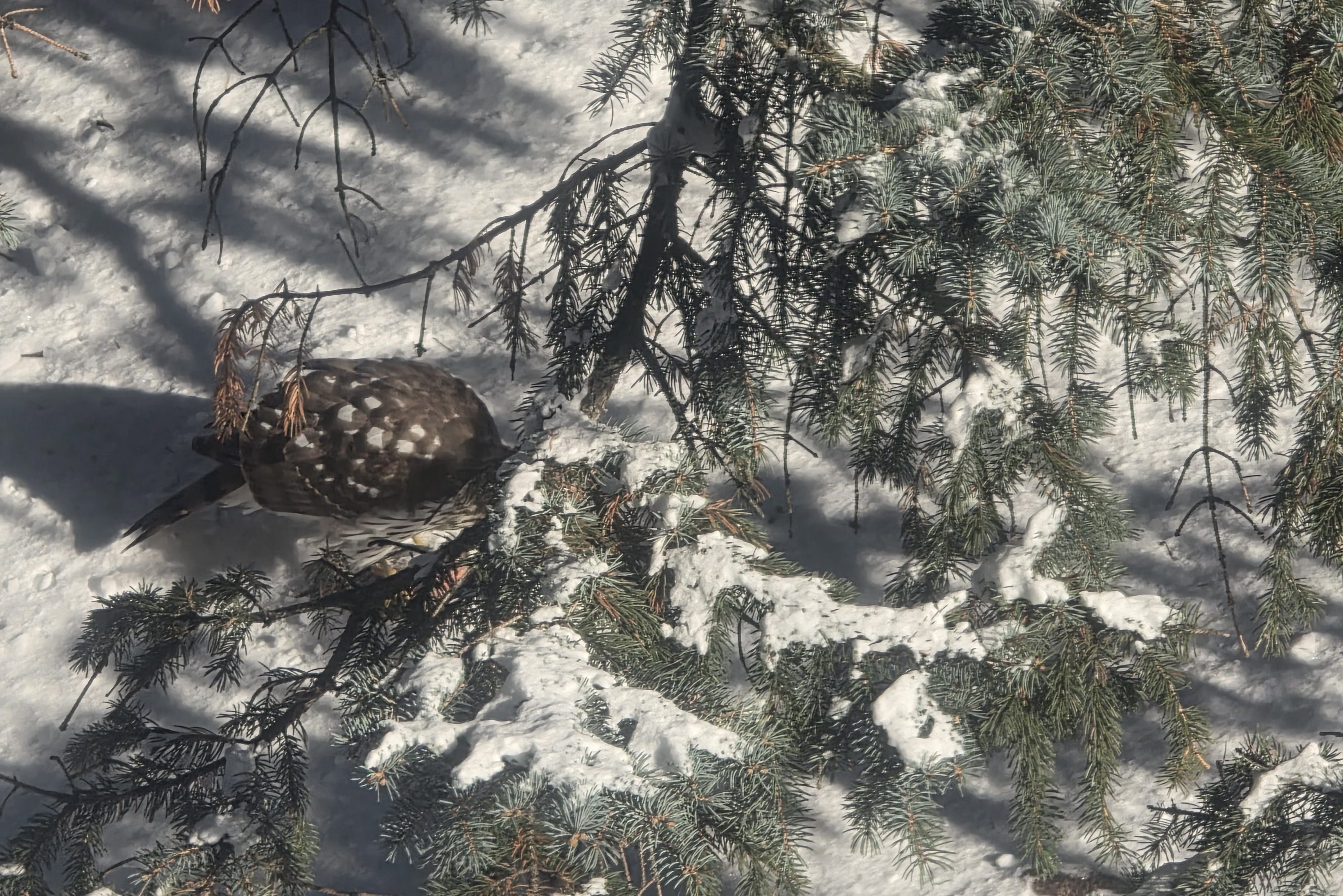
The hawk’s call is distinct, not very melodic. It’s a rather shrill, hoarse keening that’s hard to miss. Hence, it usually gets my attention, often when I’m at work, most recently on the day after our first real snow of the season, the kind of snow that creates a silent winter wonderland, a silence that allows a hawk’s cry to really stand out. 

I heard it and got up from my desk going from window to window looking for the producer of the command for attention without success. This happened several times before I finally spotted her, all puffed up to protect herself against the frigid cold, feasting on her prey beneath a snow-covered pine. 

It was a day when I hadn’t wanted to go to work. There was the snow, the cold, the violence over the past weekend: the shootings at Brown University and Bondi Beach, the tragic murder of the Reiners, all requiring a large dose of compassion as sorrow and outrage take their own course while we try to process what isn’t really possible to process. The pile-on to what we are already trying to hold is heavy, wearying for the heart. 

There are friends and family who are on challenging health journeys or are worried about someone they love on such a journey, those who have lost someone dear, others who have lost their livelihoods. How does one shine the positive light and healing energy in so many directions? How do we disburse it proportionately?

The hawk in the snow was a reminder for me that nature’s rhythms not only carry on but show the way. Any given day or moment, some of us will be stronger than others, able to carry a little more weight, called upon to stoke our own embers so we can spark or keep the flame going in others. The same has been done for each of us by friends, family, doctors, nurses, or brief encounters with someone we don’t know who was put in our path to offer just the right words or deed in a timeless dance of sharing the load and carrying the light. 

May you find and receive what you need to have the love and capacity, the strength and compassion, and most of all the spirit and heart to keep the dance in motion. 
Presence

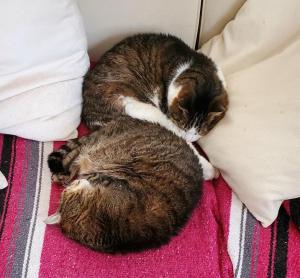
Eleven years ago, I moved from Washington, DC to New Jersey, my two sweet cats in tow, Cleocatra, then seven and Sasha, then six. It was a tumultuous move for all of us. My cats, like most, hating the disruption; me, sad to leave beloved friends and a city I had called home for nearly 20 years. But it was perhaps hardest on Sasha. She alternated between loud crying and mewing the whole gray, drizzly ride here. I realized too late that I should have sedated her. Upon arrival at our new place, I went to free Cleo and Sash from their carriers, but by then Sasha was literally catatonic and unwilling to come out.

When she finally did emerge, after movers were gone and the three of us were left to wander among our boxed belongings and furniture, she was both scared and furious. She had never been prone to jumping, but I started to find her on high surfaces—the top of a high set of shelves in the bedroom, the top of the refrigerator, atop a four-foot marble ledge in the bathroom. Communication from her was reduced to growling and hissing. I was bereft. Had I broken this beautiful, sweet, loving soul? 

While I tried to coax her to calm, offering treats and assurances to no avail, Cleo simply sat still and let her hiss and snarl at her, never engaging or taking flight. She stayed close when Sasha clearly wanted nothing to do with her. It took a few days, but I came home one afternoon from an errand to find the two cats on the bed, Sasha nestled into Cleo just as she had always done.

I recently had an elective surgery that brought a widespread surge of support from a network of friends, family, and colleagues near and far, each person providing me with something the same and something different from the other in the form of steadfast love and encouragement and, in some cases, practical assistance. It has been humbling, to say the least. I have been reminded anew of how presence is anything but simple or insignificant. It is often the most loving, holy act we can do for one another.  Just ask the divine Cleocatra and Sasha, still beaming their steady light in my world. 

May the light and comfort of loving presence and the fount of gratitude that springs from it be yours. Happy Thanksgiving days one and all.  

I Am Speaking, Are You Listening?


On a chilly morning after a sleepless night, I shuffle-walk toward my friend Barbara, a silhouette of herself in the dim morning light. In another week it will be dark at this hour. We exchange murmured good mornings, as if we might disturb someone.

“Which way?” 

I look to my left and right. “Not the hills.” The hills are for mornings after good sleeps with a weekend on the horizon.

Conversation takes time, picking up pace as we get used to the temperature and build our stride. In 50 minutes, sometimes we do not talk much. Other mornings there is not enough time to cover everything. 

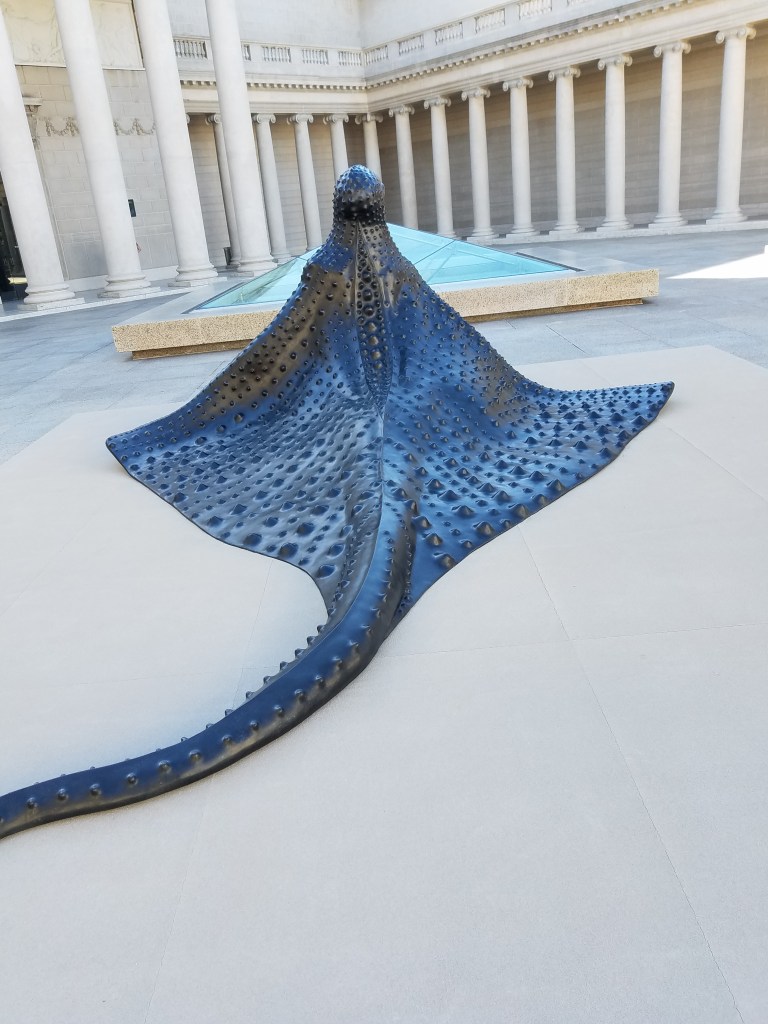
I try unsuccessfully to describe the Wangechi Mutu “I Am Speaking, Are You Listening?” exhibit at the Legion of Honor in San Francisco. Words are inadequate to express how her art, the scope of her imagination, utterly captivated me in every way, how she explores the intersections and overlaps of the socio-political, the environment, spirit, beauty, and how on tough days I try to channel the power and grace of her chimerical sculpture Mama Ray. Half Manta ray, half woman, she is regal, stunning, provocative. I tell Barbara I feel like a fish out of water. She says that’s because I am, and then assures me it’s not a bad thing.

Barbara, a mother and physician, is more pragmatic than I. As we watch the sun rising over the Hudson toward the end of our walk, she tells me about an app called Twiage that a friend of hers developed that is revolutionizing the way ambulances communicate with hospitals. I am truly captivated again, in a different way, by this story of innovation and hope, aid for the overtaxed health care field.  

Her young son has the soul of a poet. The recent death of a fish required a card to go on the journey with the dearly departed: “Good Bye Fish. I Miss You Fish.” I say a silent prayer-wish that his heart remains loved and protected, that the flame of compassion is never extinguished. I’m reminded of the disproportionate amount of goodness, love, and healing children beam into the world, effortlessly and unwittingly balancing energies so the rest of us can carry on.

The sun is up. I part ways with my friend, spirit renewed. I will not need to be Mama Ray today. And I am listening. 

The Sound of Silence

Growing up in the Midwest, I learned at a young age that eerie outdoor silence is nature’s harbinger of severe weather–calm before the storm. The wind might kick up a little, but the birds and animals are keeping quiet vigil in their safe houses. Recent events have me asking myself, why didn’t I hear the silence before the storms?

Silence, it could be said, has a multiple personality disorder. Silence can be a warning, yes, but it can also be an emotional weapon—the silent treatment—a passive aggressive punishment. And silence can be a sign of depression, ennui or a certain kind of impotence—an inability or unwillingness to take action. Silence exerts power, significance and solemnity when she walks or sits in silent protest.

I’m a big fan of the good silences. I know that when I practice meditation it makes me calmer and clearer. There is peace in silence when you can find a sliver. I also believe an intentional moment of silence alone or with a group holding vigil is holy, and a way of radiating peaceful, positive energy to salve the crackling rage and violence that is smoldering just below the surface all around us ready to conflagrate anywhere at any time like it did in Las Vegas.

It has become a tradition for US lawmakers to hold just that kind of moment of silence after a major tragedy. Some of the Democratic lawmakers refused to partake in the ritual after the mass murder in Nevada stating it was not enough anymore. Several social justice groups and individuals also made that declaration. What we need is action, not silence, on gun control and not just on bump stocks and other similar devices, though that’s being touted as the first step toward “real” gun control legislation.  How long will that take? And how many more silenced lives?

Gun control is a particularly divisive issue in the US; the UK took further legislative action in 1997 after the Dunblane massacre of the previous year.  Here we have massacre after massacre and still cannot kick our addiction to guns and violence.

We need the silence of contemplation and the rational, just action that arises from it en masse.  Because more storms are coming, and we have run out of safe houses.

Some sites to check out if you wish to become more involved:

The Coalition to Stop Gun Violence

Women Against Gun Violence

The Law Center to Prevent Gun Violence

Every Town for Gun Safety


Cain Is Abel

For many years now I have walked through the woods on the cliff along a dirt path to a clearing near the George Washington Bridge where the view turns decidedly urban. To the south is the Manhattan skyline—inviting, intimidating, energizing and enervating all at once. The bridge itself is also impressive. About 500 feet shy of a mile, the double-decker, 14 lane suspension bridge carries over 100 million vehicles a year. From my perch at the west side of the GWB, I can see many of those cars and trucks crossing.

It has long been a silly game of mine to read the signs on the trucks and find a takeaway from the oracle of the GW Bridge. I might get a message right away, or I might have to watch dozens of trucks. Shred It. No. Budweiser: King of Beers. I don’t think so. White Rose: You deserve the best. Yes! More than once, I’ve been captivated by the tagline on a logistics company truck: Kane Is Able.

I saw a Kane truck not long after I read about the suicide of 27-year-old Aaron Hernandez, the once promising pro football player turned convicted murderer. On a larger scale, it made me think of the wars ongoing and those that seem to be looming too close on the horizon, of the immigrants and of all of the displaced and how divided we are in our stances. The erosion of democracy is a real threat in places we never thought it would be. On the heels of the Climate Change march, I think of the ways we have collectively abused and continue to abuse our Mother Earth and how some still don’t believe global warming is real. Civil rights, basic human rights and the sanctity of life all hang in the balance.

It is uniquely human that we have the ability to make choices and to take sides. The danger is in feeling too righteous about the sides we’ve chosen, leaving us stranded on islands without bridges. Each side couches their differences as moral outrage, and I struggle with the idea that the middle ground seems to have gone so far underground as to be nonexistent. We are living in a world of wild extremes. Islands.

The peacemaker George Mitchell said: “There’s no such thing as a conflict that cannot be ended. Conflicts are created, conducted and sustained by human beings. They can be ended by human beings.”  Desmond Tutu said: “If you want peace, you don’t talk to your friends. You talk to your enemies.” Is Cain able?


There is the mud, and there is the lotus that grows out of the mud. We need the mud in order to make the lotus. –Thich Nhat Hanh

Stay Woke

The older I get, the less in touch I am with latest lexicon of street slang. I only first heard the phrase “stay woke” when I attended the Martin Luther King Day event at Riverside Church.

For those who don’t know, “stay woke” means to stay informed and conscious in turbulent times and to be vigilant about and critical of the media machine and the establishment and ready to act. The phrase first gained traction in the African American community after the police shooting of Michael Brown in Ferguson, Missouri. When I heard it, it quickly gained traction in my heart and soul, reverberating there like a drumbeat and repeating in my mind like a mantra.

That mantra thrummed in me on my way to Washington, DC where on January 21st I joined friends, and what globally turned out to be millions of others, for the Women’s March. Claustrophobic as I am, it was good to be among so many like-minded people, walking, talking, laughing and standing in solidarity.

I spend a good deal of my energy these days trying to understand what happened in our country, what is currently happening here, and what might happen here, how we affect other countries, as well as trying to figure out when and how to respond. I wonder if the endless online petitions I’m signing (slacktivism) and the ongoing protests are making a difference.

I’ve been doing a little reading on that subject (The Washington Post, Vox, and others) and while there is some disagreement about the efficacy of those actions, most of the articles I read claim that slacktivism and protests do work with varying degrees of success. They raise awareness and deepen understanding. They show commitment and foster activism.  It takes time to know their impact. They give hope. The spontaneous protests in response to the immigration ban were heartening, as were the responses by judges, attorneys general and mayors of major cities. But now we have the so-called “routine” raids targeting undocumented immigrants. With each heartening act it seems there is an equally disheartening one that tests our resolve and challenges us every day to find new ways to recommit to what is just.

Brexit and the election of Donald Trump by the Electoral College were choices driven by fear. Those of us who did not agree with the outcomes are now living in fear of the ramifications. The harmful effects of the energy pollution of that collective fear are impossible to know or predict but I believe very real.

What makes fear recede? Breath. Hope. Light. Laughter. Sight. Action. Huddling together. Living life. Remember how turning on the light when you were a child and afraid of the dark made the fear go away? Turn on the light. Stay woke. Stay woke. Stay woke.