Hawk’s Call

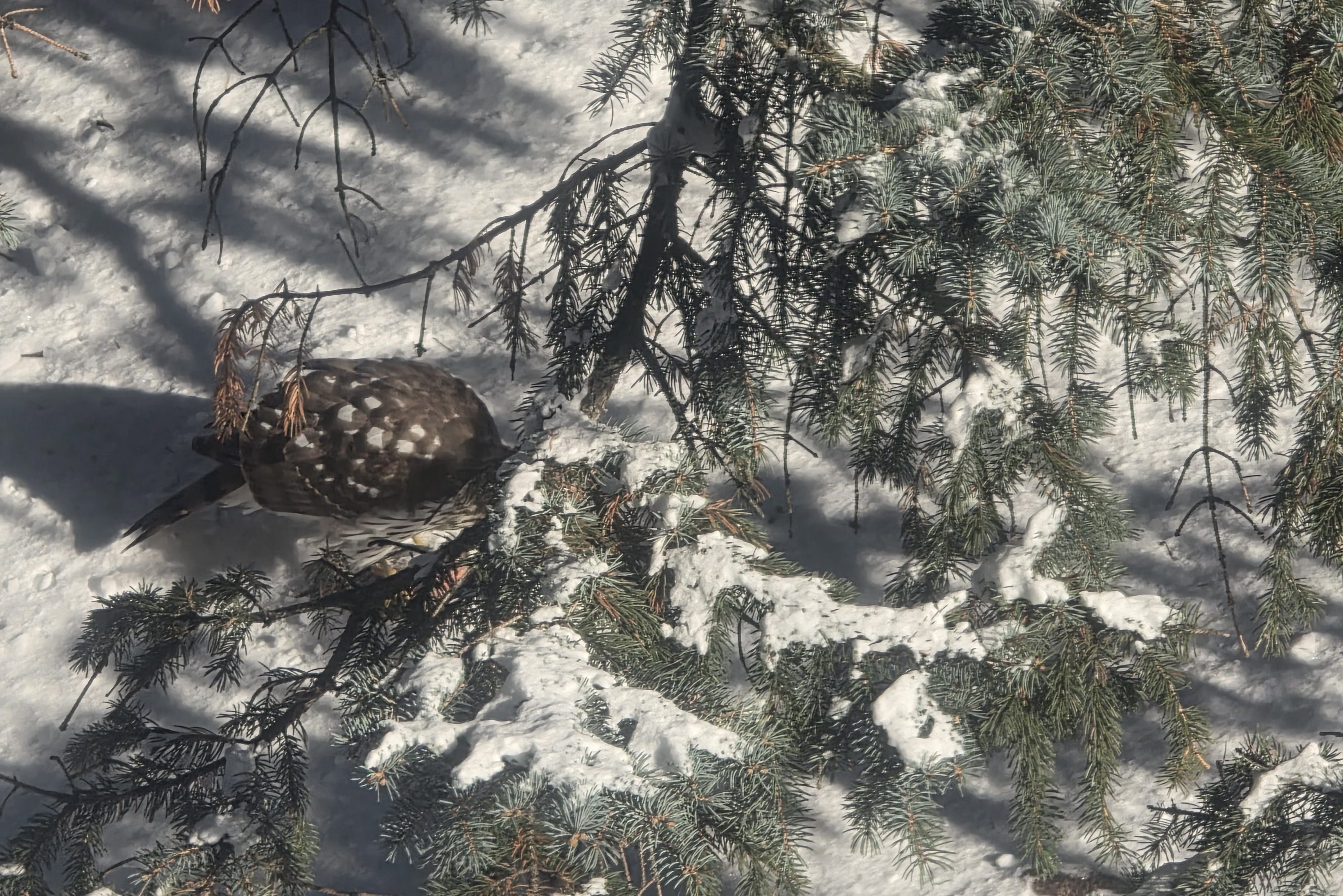
The hawk’s call is distinct, not very melodic. It’s a rather shrill, hoarse keening that’s hard to miss. Hence, it usually gets my attention, often when I’m at work, most recently on the day after our first real snow of the season, the kind of snow that creates a silent winter wonderland, a silence that allows a hawk’s cry to really stand out. 

I heard it and got up from my desk going from window to window looking for the producer of the command for attention without success. This happened several times before I finally spotted her, all puffed up to protect herself against the frigid cold, feasting on her prey beneath a snow-covered pine. 

It was a day when I hadn’t wanted to go to work. There was the snow, the cold, the violence over the past weekend: the shootings at Brown University and Bondi Beach, the tragic murder of the Reiners, all requiring a large dose of compassion as sorrow and outrage take their own course while we try to process what isn’t really possible to process. The pile-on to what we are already trying to hold is heavy, wearying for the heart. 

There are friends and family who are on challenging health journeys or are worried about someone they love on such a journey, those who have lost someone dear, others who have lost their livelihoods. How does one shine the positive light and healing energy in so many directions? How do we disburse it proportionately?

The hawk in the snow was a reminder for me that nature’s rhythms not only carry on but show the way. Any given day or moment, some of us will be stronger than others, able to carry a little more weight, called upon to stoke our own embers so we can spark or keep the flame going in others. The same has been done for each of us by friends, family, doctors, nurses, or brief encounters with someone we don’t know who was put in our path to offer just the right words or deed in a timeless dance of sharing the load and carrying the light. 

May you find and receive what you need to have the love and capacity, the strength and compassion, and most of all the spirit and heart to keep the dance in motion. 

Eternity

Image by Dimitris Vetsikas from Pixabay 

What is eternity? Is it real or imagined? 

Years ago, I was hanging out with a friend while she prepared dinner and we waited for her husband to get home. Her then five-year-old daughter came into the kitchen and asked when we would be eating. “Five minutes,” my friend replied, whereupon her daughter crumpled to the floor and wailed, “Five minutes?! Five minutes?!” An eternity.

When my brothers and I were just a little older than that, we would sit at the top of the stairs on Christmas morning, the two older ones in front, my younger brother and I two steps above, waiting for permission to go downstairs. Eternity.

One of my grandmother’s used to say the definition of eternity was two people and a ham. Eternity is defined by Merriam-Webster as: forever, infinite time, the state after death: immortality, a seemingly endless or immeasurable time. Eternity has the sense of being both definable and indefinable, a state that can be applied to a myriad of emotions, a word used in exaggeration about circumstances. By definition eternity is challenging.

Longing, waiting, and anticipation often accompany eternity, sometimes joined by impatience. There is a painful disparity in waiting in quiet or joyful anticipation for what seems an eternity measured against waiting in silent agony for an unwelcome event or outcome or waiting on hold or in traffic in frustration for what seems an eternity. 

Advent is a time of waiting and expectant joy for many, and in the best moments, a time of peaceful stillness, connection. For others it’s a time of stress and a season to endure, a time where some are excluded, a season that can bring both welcome and unwelcome versions of eternity. And for some it eternally holds no waiting or meaning at all.

Like the one great sea that varies in temperament depending on where it is in the world, we hold the dark, stormy and unpredictable within along with the deep, calm and steady. We hold that for ourselves as well as for others, including those we might call strangers who are anything but. This holding is gift and challenge requiring what nature constantly demonstrates in a steady rhythm: presence, stillness, attentiveness, patience, listening, watching, waiting, silence, inherent faith that we are tethered together in a boundless sea of eternity. 

Altarations for the New Year

UnknownTake all the secrets and shame from the vault and lay them open on the altar of compassion where they will be burned with sage and sweet grass, then rinsed away with a tincture of holy water, lavender and mercy.

Lie down on the granite altar of pain and offer your sorrow as sacrifice. Let the flying buttresses and the bowl of the apse catch your soul’s keening. Be soothed by the cool stone beneath you. Hold steadfast that a light heart will beat again.

Kneel before the altar of humbleness and receive the host of gratitude and forgiveness on your tongue. Sip bittersweet from the chalice of chance and experience. Rise up.

Walk down the aisle toward the altar of the flowing river draped in the morning sunlight. Slip on the ring of promise, and vow to start each day with a sacrament of beauty.

Dance on the refracted colored light on the floor of the nave before the altar of joy to a jubilant chorus raising the cathedral roof singing of your goodness.

Gaze up to the hawk’s shrill cry, follow flashes of cardinal and streaks of blue jay, glides of tawny sparrow to where they adorn the shrines of mighty oak and pine, and woodpeckers tap their praise.

Gild the altar of life with fragrant flowers, the finest threads and most vivid colors. In exaltation, summon forth courage and creativity; bless the arts and music. Welcome with open arms all who are bold enough to risk.

Dip inspiration into the baptismal font of hope where doubt knows no name. Process the ashes of fear out the holy door and down the avenue in a caisson drawn by white horses.

Worship in awe-filled silence in the sanctuary of your understanding. Glorify that which you feel to be holy. Come often to be centered and fed. Shout Hallelujah! Chant om, shanti, shanti, shanti. Namaste. Amen.


Incarnation

nico-frey-722847-unsplash.jpg
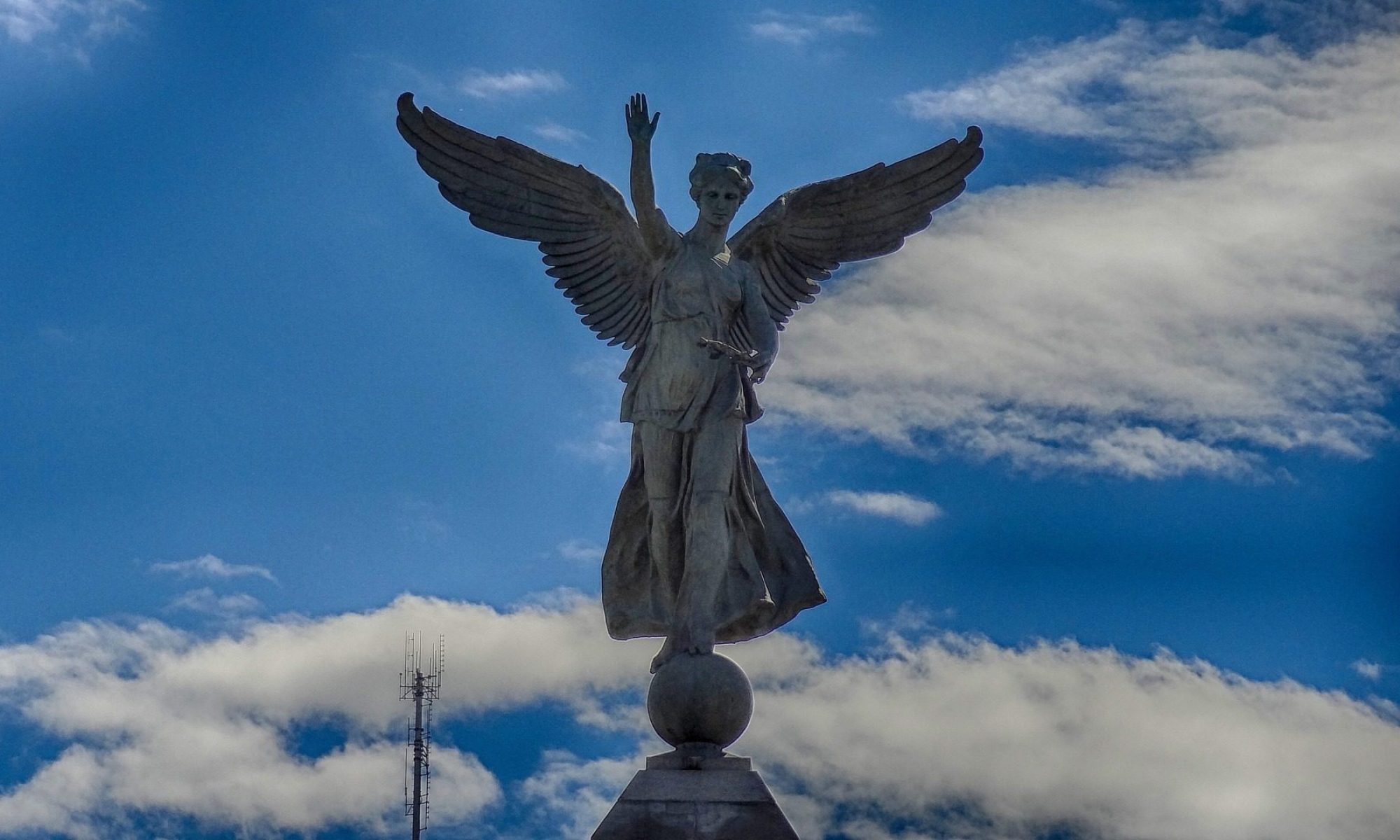
Blades crack, sinews pull, a pinion forces a tear creating space for the next, and the next, and all that come after. Torso drops forward to support the transformation. The invisible unfolding is swift. Arching upright, wings expand to full. The familiar weight rests easy, feels good, is a comfortable carry.

These are not strap-on, costume feathers for fun or show. They go entirely unnoticed, moving easily through busy streets, fitting comfortably on crowded subways and planes, in tiny elevators and hospital rooms with humming machines, blinking lights, ambient exterior noise, blurring days. There is nowhere they don’t or won’t go.

They enter cavernous silences bringing offerings of what is needed–a gentle touch, an unexpected smile, a compassionate heart, unconditional love made easy. They bring the hands and hearts that treat the sick, that help those stuck in the snow, that pamper with haircuts and massages, tend and comfort the children, feed the hungry, adore the animals. Their ears patiently listen; their hearts make soft landing for vented anger and fill the cup with laughter on days that teeter on the edge of sorrow. It takes but a sliver of grace inserted in a gaping ache.

So effortless and unconscious the alteration, sometimes you forget who you are, that you joyfully made the promise when you signed the covenant to come. Yes, there are the troubled days in between, transformation stunted or thwarted, leaving in your wake misfired mercy and smoky, ruffled plumes. But for the most you bring the peace, hoist the courage, set things right for at least one in some significant way. You are the guardian and incarnation of the angel you shelter.

Red Herrings

A good mystery keeps you guessing up until the end, or at the very least, leaves you satisfied when you figure out who done it before it’s revealed. It does this by throwing out red herrings, clues that are intended to be misleading or distracting. Typically, several prime suspects are involved. Seemingly innocent people connected to the crime or murder by association with the victim become prime suspects by having no alibi or witness and by unexpected behaviors–the local priest having an affair, the quiet elder shopkeeper who has a dark, secret past. That doesn’t necessarily make them guilty, but it does make them intriguing and persons of interest. Shadow sides are brought to the fore in mysteries.

We all have them. Regardless of the level of self-awareness with which we’ve lived or tried to live our lives, we can still be caught off-guard by our shadows. A trigger, a mood or too much stress–all can cause us to behave in ways that surprise or disappoint us. In fact, we can become like red herrings, confusing not only people around us but also ourselves!

What ensues when the shadow is triggered is not always a pleasant play of shadow and light. Depending on the situation and the depth of emotion attached to it, it can take days to put the shadow to rest. For most of us, this is a delicate dance, whether we’re wrestling with our own shadow or have been caught in the crossfire of someone else’s or both. Examining the darker side can be like solving a mystery.

If we lived in a world that was made up only of light or of darkness, we would never see one another, much less our own reflections. Complete light is blinding, as is total darkness. Forgiveness is of necessity wrapped up in examining our shadows, as is tenderness. Love, especially of self, is what allows us to stay with the mystery, to let go of the red herrings and focus on the light in the mirror.

The Wonder and Work of Christmas

Somewhere around Thanksgiving I start to feel uneasy about Christmas and my increasing lack of connectedness to it. The relentless bombardment of advertising for endless sales feels like psychological warfare, an assault reinforced by the inescapable ambient noise of tinny carols. I worry about people who do not have much, the financial pressure they live with all year mounting to a crescendo at Christmastime. My heart is always with addicts and people suffering from mental illness and those who love them. Christmas does not necessarily bring a break in abusive situations. Holidays can be stressful for so many.

Yet somehow, some way, the wily wonder of Christmas will woo me.

This year I am awed as I follow the Facebook page of a friend of a friend, parents who have a two-year-old battling cancer. Their courage, faith and strength make me marvel anew at the boundless capacity of love.

My colleague routinely updates us on a refugee Afghani family he and his congregation are journeying with: finding them an apartment, taking them to medical exams, lining up ESOL classes and helping to find employment, welcoming the stranger.

On a favorite annual trip with friends to Old Ebbitt Grill in Washington, DC, we are delayed for a moment by a homeless man selling copies of his book, Homeless Lives Matter. Indeed, they do. After a delightful hour or so inside, as we prepare to leave, one of my friends witnesses the bartender refusing another homeless man’s money, handing him a beer on the house, restoring my faith in the generous, compassionate heart. Everyone deserves dignity.

I love decorated trees, the smell of holly and greens. I am enchanted by the lights that deck the streets, the halls and just about everything in sight. I relish traditions with friends and family. And I confess I cannot make it through a verse of Silent Night without crying. It’s not Christmas I am not connected to–it’s the commercialization of it. But I should know better by now; wonder cannot be short-circuited or smothered.

My favorite Christmas poem is Howard Thurman’s The Work of Christmas. May we all know the wonder and light of this season and remember the work of it always.

The Work of Christmas
by Howard Thurman

When the song of the angels is stilled,

When the star in the sky is gone,

When the kings and the princes are home,

When the shepherds are back with their flock,

The work of Christmas begins:

To find the lost,

To heal the broken,

To feed the hungry,

To release the prisoner,

To rebuild the nations,

To bring peace among brothers,

To make music in the heart. 


Grateful for Grace

On the eve of Thanksgiving here in the States, naturally I am thinking of gratitude. That said, gratitude is not just for Thanksgiving. Many people have a daily gratitude practice, either journaling what they are grateful for or taking time to reflect on gratitude. This practice is said to have numerous profound benefits, including making us happier, healthier, more spiritual and better sleepers. For a complete list, visit the Happier Human website.

That’s good news, but a few other things caught my attention on the subject recently, including a suggestion from an online astrologer–yes, an astrologer–“to give thanks for what once may have seemed to be a liability or problem.” Now that’s something to think about.

Elizabeth Briel, in A Book of Grace-Filled Days (2013), for November 23, writes:

I will give thanks to you, O Lord, with all my heart – Psalm 9:2
Note how often the whole heart is referenced in Scripture. This implies that nothing is held back, that no part is hidden or kept to oneself. Are there parts of me I am trying to hide and control? Are there aspects of my life for which I resist God’s healing touch?

Could it be that the parts of ourselves that we most ignore or try to hide or control are the parts that most deserve our attention, gratitude and perhaps our forgiveness? That requires an openness, an invitation to grace. Grace is a mysterious gift, never unwelcome, often bestowed when we least expect it. It is not the nature of grace to always be direct or obvious; sometimes it is the opposite of what we think we know or what we expect or desire.

I am thankful for much, including and especially medical professionals and caregivers, and for the grace-filled people in every single service industry. But I am also grateful for the grace that has come my way in unexpected packages, for sorrows that I hope make space for deeper compassion and for a light that somehow refuses to be snuffed regardless of the weight of our world.

Magnificence!

We have come into this exquisite world to experience ever and ever more deeply our divine courage, freedom and light!” Hafiz

In her book Dying to Be Me, Anita Moorjani writes about her near death experience, which occurred when she was losing a four-year battle with cancer. Rushed to the hospital, she went into a coma and was not expected to live. She refers to the place she went while in the coma as another realm.  While in this realm, her powers of perception were magnified so that she was taking in much more. She was able to see and hear what was happening in her hospital room and beyond.

There is much in her experience that is profound and amazing, so much so that at times she confesses she doesn’t have words to properly describe it. She writes of feeling the magnificence of her soul and of being completely fearless and overwhelmed by love. She was also able to see the myriad life connections, how every soul is connected, how every living thing is connected and has a unique and important part to play. In this state, realizing who she truly was, Moorjani was able to make the decision to return to life on this plane, though she was more than content in the other realm. She knew when she returned here she would fully heal, which she did, stunning her doctors and her family.

Moorjani’s message that our souls are magnificent cannot be overstated. It’s the type of message, however, that we tend to take at face value and not fully internalize. What if we were to truly believe that we are magnificent and perfect just as we are? Would we then rejoice in who we are? Rejoice in our magnificent lives? How would it affect the way we interact with and treat one another? What if we truly understood the meaning of the connections in our lives, even the ones that seem sour, and that each person we encounter is important to us in a unique way just as we are to those we encounter?

Times are unsettling and uncertain right now, which may make it the perfect time to recognize our personal wattage, to magnify and expand our light.

Divine Ready

Not long ago, I woke up with the words “divine ready” in my head. The message might as well have been Sanskrit in terms of my ability to decipher it. Was the Divine ready for me, or was I supposed to be ready for the Divine? Had a celestial being stuck a numinous fork in me while I slept and pronounced me ready to come out of the oven? And if so, it’s about time! Who knew I would be a slow cooker that took decades to roast to heavenly readiness?

I have been pondering the celestial message ever since. Maybe a word was lost between sleep and waking and the message was really intended to say, “Be divine ready.” That sounds simple enough. In fact, aren’t we all divine ready from the moment we’re born? There is a difference, though, between showing up willingly and open to receive and showing up tuned out, playing our same old songs, not open to new rhythms and beats which may carry life-giving, life expanding messages.

Truly being divine ready may take some effort and attention, listening with not just our ears but with our hearts and every divine cell of our beings. It might mean being present and sometimes still, going with the flow instead of anticipating it or trying to direct it, experiencing the divine in absolutely everything from anxiety about impending news to dashed hopes and expectations to unanticipated joy and surprise encounters.

It does not have to be—and usually isn’t—spectacular and yet, what about every breath is not spectacular? The Divine is, was and always will be ready. Are we ready for the Divine? I am staying tuned for some new music, keeping my eyes open, trying to decipher if the tinnitus in my left ear is really an angel speaking to me, and remaining open to new possibilities with every breath.