Tack så mycket!

If the only prayer you ever say in your entire life is thank you, it will be enough. ~Meister Eckhart

About a week after we had my stepmom’s celebration of life, out of nowhere, I heard “Tack så mycket” in my head. Swedish for “Thank you so much,” it’s a phrase I heard often growing up, a phrase I should be saying to her morning, noon, and night.

It came into my head again today when I got home, after a conversation I had with a friend wherein I told her I didn’t feel like writing about gratitude, even though with Thanksgiving on Thursday, it’s prime time for an appreciation reflection. It’s hip to be grateful these days. It’s become not just a spiritual practice like meditation and prayer but also marketable through all the usual channels. Are we more grateful as a result? I worry I’m missing something, that I’m not doing gratitude right, not journaling enough—or at all—about it, not feeling it enough, not spreading it around properly. 

Hearing tack så mycket again in my head made me think it was my Swedes on the other side telling me that’s what I needed to write about whether I wanted to or not, maybe then a river of gratitude would flow from me. That phrase, first heard in my childhood, also made me wonder when I first learned about and expressed gratitude. At least initially, it was often tied to gifts.

My brothers and cousins and I had to write thank you letters to our grandparents for Christmas and birthday presents. Some of those letters are now in my possession. If they touched and amused my grandparents as much as they do me now, then they were well worth writing.

Gratitude is born of and begets love, so writing a thank you note is an act of not only gratitude but love. I’ve often thought it would take a book, possibly a series of them, to express the proper amount of appreciation to all the people I’ve met, known and loved and for all the care, kindness, forgiveness, gifts of every sort, and blessings that have been bestowed upon me, not only by people I know but by strangers. Maybe that’s in my future. For now, river flowing, tack så mycket to you, and you, and you!
Thanks

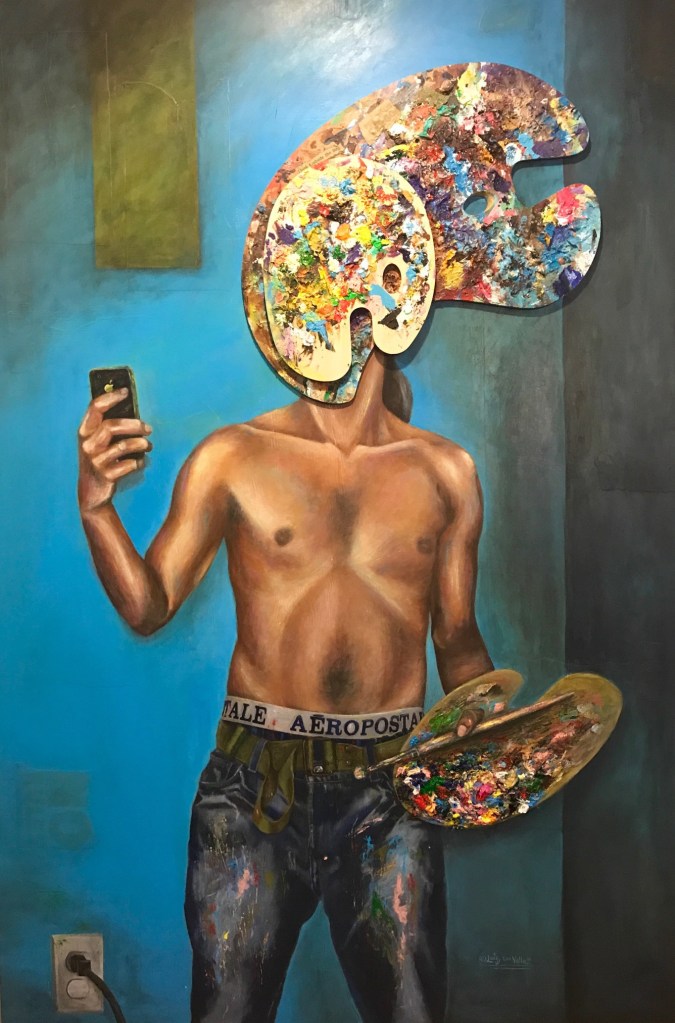
Selfie inside-out by Luis Del Valle. To see more of Luis’s art and learn more about him visit: https://www.lovehopeart.com/

Midway through the walk from Allison Park to the George Washington Bridge there is a pair of benches that overlook the Hudson River, one facing South to the city, the other towards the Bronx. They are usually occupied, but on a recent Saturday during a gentle rain I found them free and decided to stop. That’s when I discovered that a graffiti artist had been there before me.

I’ve never cared for graffiti in nature. But on graffiti in general my thoughts have run the gamut over the years from detesting it to a desire to understand it to outright appreciation in some cases. Was that “Thanks” written on the lower right corner of the Bronx bench? No, on closer inspection it was an indecipherable word.

I continued my walk, the graffiti taking me on another walk in my mind. Years ago, I met a graffiti artist when he was painting a mural on a bridge in my neighborhood. At the time, I was writing a column called “Meet Your Neighbor” for DC North, a community paper in Washington, DC. I asked Luis if we could talk.

Luis’s family fled Nicaragua during the Contra war and eventually made their way to DC where, in the early-90s, a different sort of violence was taking place. Addicts, dealers, and gangs were prevalent in Luis’s neighborhood. When we met, he had resisted the pressure to join a gang and personally knew eight people who had been killed that year. At the same time, Luis was being pulled more deeply into art. A teacher recognized his talent and got him into the Corcoran School of Art. Less than a mile from where he lived, he told me he found a whole world he never knew existed. A mentor there encouraged him. Now a successful artist with his own family, he is active in his community and teaches young artists.

We each have so much power. With it comes opportunities to sow hope, foster growth, possibly change the trajectory of a life. Reflecting on Luis’s story, I remembered some of the people who altered my path, including the man who gave me the column that allowed me to interview Luis.

I thought about circling back to take a picture of the Bronx bench so I could decipher that word in the corner, but I decided it was better to remember my first impression. And when I got home, I took a lipstick that doesn’t get much play these days and scrawled my own graffiti across the bathroom mirror: “Thanks”.

Follow Your Heart’s GPS

UnknownBrian Doyle wrote a wonderful book called The Wet Engine: Exploring the Mad Wild Miracle of the Heart. It was in this book that I learned a hummingbird, with its rapid heartbeat and two-year lifespan, has the same number of heartbeats a human has in a lifetime, and that at 5’ long, 4’ wide, 5’ high, weighing 400 pounds, the heart of the blue whale is the largest on the planet. The human heart weighs in at 10-12 ounces and is about the size of a fist.

“Nobody has ever measured, not even poets, what the heart can hold.” So said Zelda Fitzgerald whose heart, one imagines, experienced the gamut of emotions in her extraordinary and ultimately tragic lifetime.

Gratitude and wonder hold hands in the heart, wide-eyed and a little gap-mouthed, ready to be delighted and surprised at any moment. Stress and tension, handcuffed together, frequently lurk uninvited. Forgiveness fights fires. Grief, normally in chambers, engulfs when awoken. Favorite people wander the corridors, places and things take up space in different rooms. And yet, as Zelda suggested, the heart’s ability to expand and hold more is unknown but likely vaster than a blue whale’s heart.

When alert and not operating by rote, the heart possesses the extraordinary vision of a raptor seeing things in focus far and wide, making connections like the way the forces of darkness often push the better angels to prevail, and how the persecuted sometimes carve the path to compassion and change. It has the ability to hear like a moth, to float and flutter with the same grace. The heart feels best with arms widespread, guileless, loyal and loving as a child or a pet.

It truly has a mind of its own, which is in constant communication with the brain in our heads. When heart and head are in sync, we have greater mental clarity and intuitive ability. When the heart experiences emotions like compassion and appreciation, its rhythm becomes more coherent and harmonious. So next time you feel adrift, take a quick minute or two to listen to and follow your heart’s wise lead. She’ll get you where you need to be.


Grateful for Grace

On the eve of Thanksgiving here in the States, naturally I am thinking of gratitude. That said, gratitude is not just for Thanksgiving. Many people have a daily gratitude practice, either journaling what they are grateful for or taking time to reflect on gratitude. This practice is said to have numerous profound benefits, including making us happier, healthier, more spiritual and better sleepers. For a complete list, visit the Happier Human website.

That’s good news, but a few other things caught my attention on the subject recently, including a suggestion from an online astrologer–yes, an astrologer–“to give thanks for what once may have seemed to be a liability or problem.” Now that’s something to think about.

Elizabeth Briel, in A Book of Grace-Filled Days (2013), for November 23, writes:

I will give thanks to you, O Lord, with all my heart – Psalm 9:2
Note how often the whole heart is referenced in Scripture. This implies that nothing is held back, that no part is hidden or kept to oneself. Are there parts of me I am trying to hide and control? Are there aspects of my life for which I resist God’s healing touch?

Could it be that the parts of ourselves that we most ignore or try to hide or control are the parts that most deserve our attention, gratitude and perhaps our forgiveness? That requires an openness, an invitation to grace. Grace is a mysterious gift, never unwelcome, often bestowed when we least expect it. It is not the nature of grace to always be direct or obvious; sometimes it is the opposite of what we think we know or what we expect or desire.

I am thankful for much, including and especially medical professionals and caregivers, and for the grace-filled people in every single service industry. But I am also grateful for the grace that has come my way in unexpected packages, for sorrows that I hope make space for deeper compassion and for a light that somehow refuses to be snuffed regardless of the weight of our world.